Get to Know You Introduction Games

Most ESL courses for kids and beginner learners will brainstorm with lessons about greetings and introductions. These are frequently lessons teaching English language expressions such equally 'How are you?', 'What's your proper noun?', 'Dainty to meet y'all.', etc. Once students learn greetings and introductions in English language, this can form role of your daily classroom routine. It will also allow children to greet their friends in English and talk about their feelings.
I of the all-time ways to teach greetings and introductions to ESL kids is through fun and heady classroom games. Coming upwards with fresh classroom game ideas can be tough, so we put together this list of 5 super fun games and activities to teach greetings and introductions to kids.
Related: twenty Different Ways To Say Hello In English
five ESL Games To Teach Greetings And Introductions To Kids.
1: 'How Are Yous?' Laissez passer The Ball Game
Peak of our list is the archetype ESL classroom game 'Pass The Ball'. Laissez passer the ball can be used with whatsoever target language, simply it works especially well when teaching greetings in English language to kids. It can be difficult to get children to talk, especially when they are just beginning to learn English. Playing pass the ball is a great manner to involve all students and to become them speaking using the target language.
For this game all you need is a small-scale soft ball. To play, simply play the laissez passer the ball video in class. When the music is playing, students must laissez passer the ball. When the music stops, the student with the ball must respond the question. And so, when teaching 'How are are?', when the music stops the educatee with the ball must respond the question (eastward.g. I'm happy/bored/tired/excitied/sad, etc).
TIP: To involve the whole class, encourage the rest of the students to inquire the question together, and the pupil with the brawl can answer. This activity can be used with other greetings or introductions such as 'Nice to meet you.' – Overnice to meet you, too. 'What'southward your proper noun?' – ' My name is Kevin.'
2: 'Squeamish To Run into You lot' Game
This game is a fun way to use the greetings 'What's your name?' and 'Nice to meet yous.'. It can, withal, be hands adapted to practice other expressions. To play, place 6-8 flashcards on the lath (or simply write the words) in a horizontal line. For beginner learners, these could exist phonics flashcards, alphabet flashcards, or any other topic you want to review.
So, separate the form into two teams and choose one student from each team to come to the front. Enquire these 2 students to stand at opposite ends of the line of cards. At present the game can begin. When the teacher says 'Go!', the ii students should walk downwards the line of flashcards towards each other. As they become, they should bear on each flashcard and say what's on the card. When the 2 students meet in the heart, they should stop and greet each other. Like this:
Student A: Hi, What's your name?
Student B: I'm Kelly. What's your name?
Student A: I'm Chris. Overnice to see you.
Student B: Nice to meet you, also.
After greeting each other, students should and then play rock, pair of scissors, paper. The winner gets to stay where he/she is (in the eye of the line of flashcards). The loser must sit down back downwards. And then another student from the losing team should come to the front to supersede him/her. This student must begin again from the cease of the line of flashcards.
Again, when the teacher says 'Go!', the two students will begin walking towards each other as they touch each flashcard and say the word aloud. When, they meet they should greet each other and play rock, scissor, paper.
The aim of the game is to make information technology to all the way to the other stop of the line of flashcards. If a student gets all the style to the end, they win a betoken for their squad, and the game starts again with 2 new students
3: The Name Game
This simple classroom game is great for practicing request and answering 'What'south your name?' in English language. To play, choose one student to come to the front and stand with his/her back to the class and then they cannot run into the rest of the students (or ask them to close their eyes). So the instructor should betoken to 1 student in the classroom. This student then has a choice. They can say their own proper noun, or the proper name of another educatee in the classroom (east.grand. 'My name is Chris.').
Adjacent, the student at the forepart of the class, without looking, must attempt to gauge if that educatee was telling the truth or was pretending to be another student in the form. Kids really relish this game and it becomes a lot of fun when the students begin impersonating their classmates and disguising their voice.
4: 'How are you?' Board Games
Board games are a great manner to increase student talk time in the classroom. Here is an example of a board game you can play to teach students how to ask and answer near their feelings. You can download this game, plus many more board games from our printable lath games page.
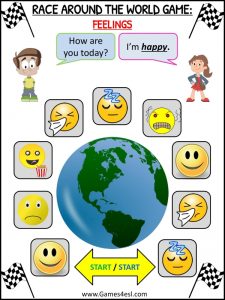
Print and requite ane board game to each pair of students. To begin, students should place their eraser at the bottom where information technology says offset. Then students should play rock, scissors, paper, and the winner tin move their eraser to the next square. After moving their eraser, the students should brand a dialogue based on the emoticon in that foursquare. For example, 'Hullo, how are you?' – 'I'm tired.'
The aim of the game is to 'Race effectually the world' and the start student to make information technology all the way around is the winner. Once pupil will go clockwise, and i anti-clockwise.
5: Greetings Mingle Game
This last ESL game to teach greetings and introductions volition get students upwardly out of their seats and speaking with their classmates. For this activeness, choose a fun ESL song that the students relish. Play the song and inquire students to walk/dance around the class when the music is playing. When the music stops, students should run into the closest educatee to them and milkshake their hands and greet them using the lesson's target language. For example, students can say 'Hi. My proper name is Chris. What's your name?', or 'Hello, how are you today?', etc.
Thanks for reading. I promise you found some good game ideas to teach greetings to ESL kids. Earlier you lot go, don't forget to checkout our FREE ESL lesson materials, including flashcards , board games , lesson plans , and PowerPoint Games .
Source: https://games4esl.com/greetings-and-introductions-esl-games/
0 Response to "Get to Know You Introduction Games"
Post a Comment